Decca, dead wax and all the infos you need
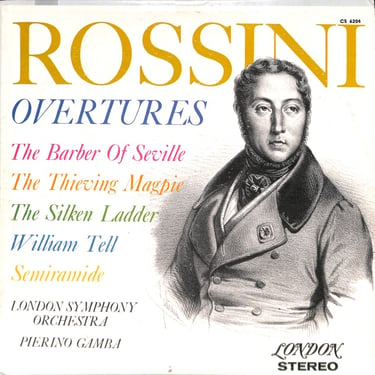
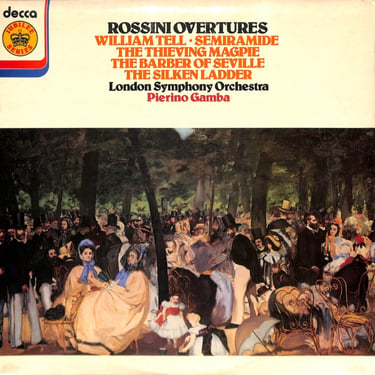
Let's suppose that we particularly appreciate Rossini's Overtures conducted by Pierino Gamba and that we own 4 different pressings of them. Decca SXL2266 UK London CS 6204 UK King SLC 1065 Japan Decca JB33 UK


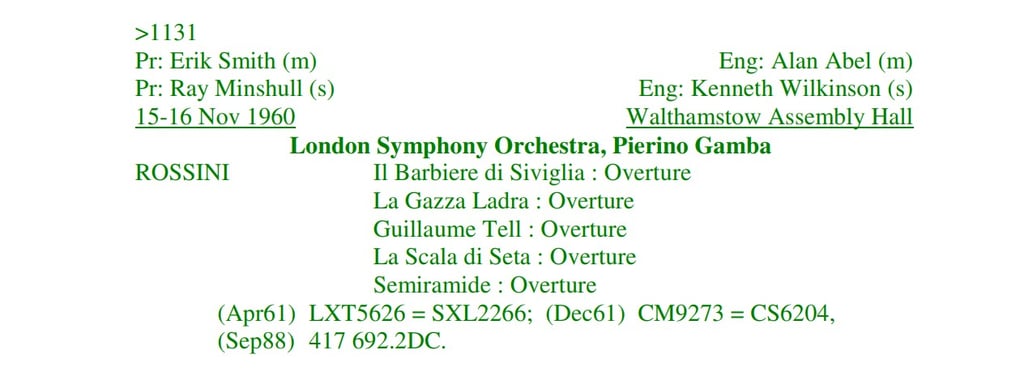
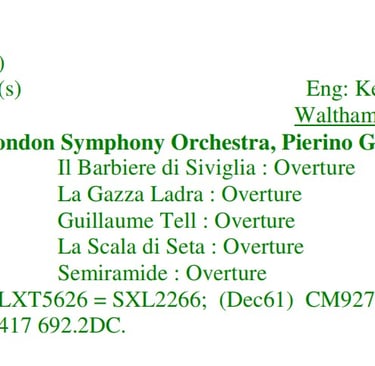
We are curious and want to know everything about the recording and on the site https://charm.rhul.ac.uk/discography/decca.html we can find all the information possible about all the classical music recordings of Decca from 1929 to 2009. We look for our record and this is the result
We learn that the recording took place at Walthamstow Assembly Hall on 15th and 16th November 1960 and that, for the stereo version, the producer was Ray Minshull and the sound engineer was Kenneth Wilkinson. (while the team for the mono version was Erik Smith and Alan Abel) We also learn that the first Decca version (SXL2266 stereo and LXT5626 mono) was marketed in April 1961 while the first London version for sale on the US market (CS6204 stereo and CM9273 mono) was marketed in December 1961.
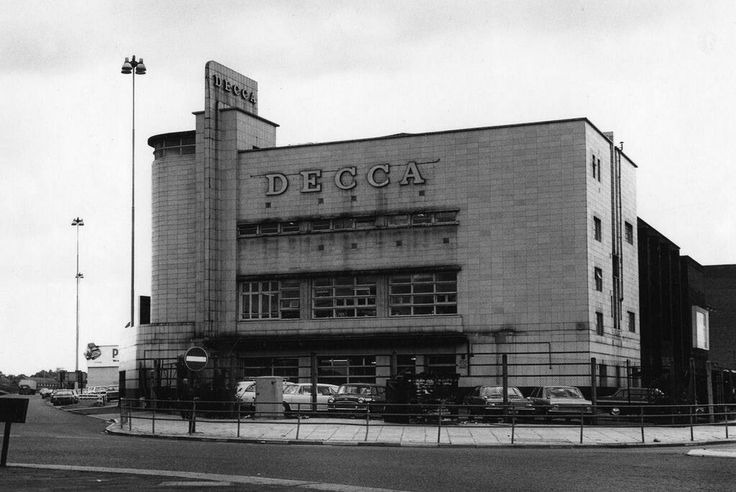
Decca New Malden factory
Now we need to investigate the disc, especially in the dead wax, that empty space between the engraved part and the label.
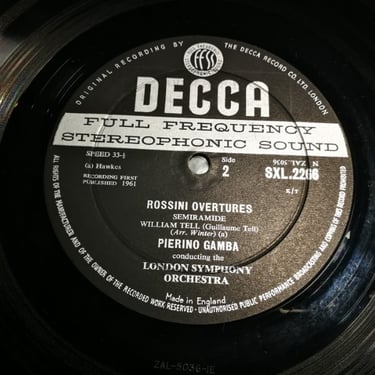
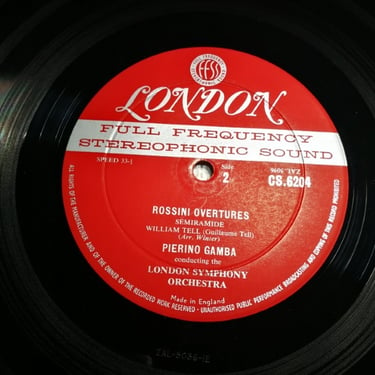
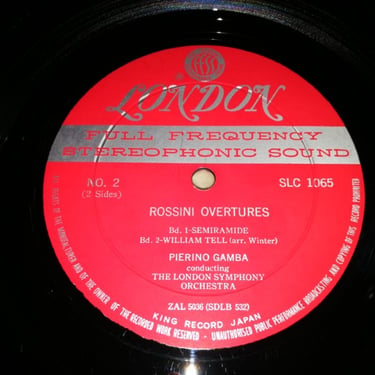
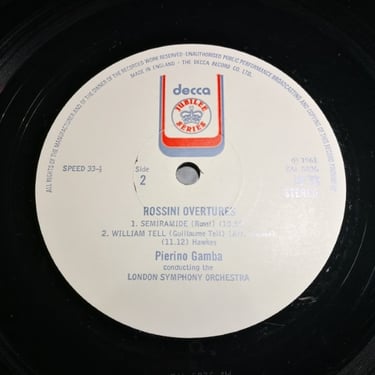
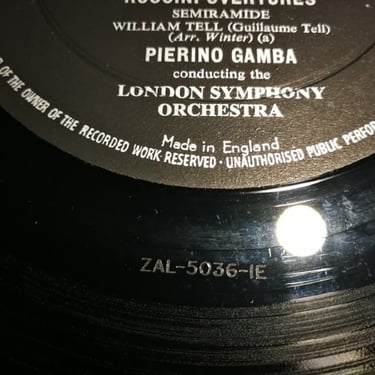
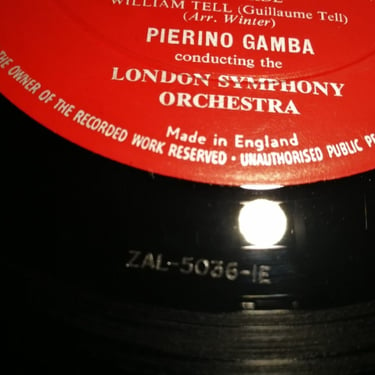
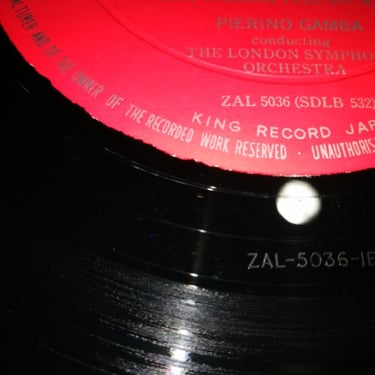
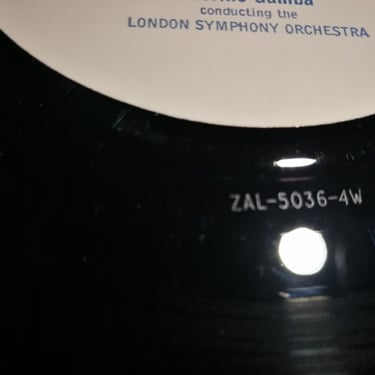
Decca ZAL5036 1E London ZAL5036 1E King ZAL5036 1E JB ZAL5036 4W 140gr 150gr 205gr 130gr
In the dead wax, looking at the label from the front, at 6 o'clock we read the engraved writing ZAL5036 1E. ZAL5036 is the progressive preparation number of the master tape used to record side 2, while the master tape ZAL5035 will be used to record side 1. The prefix ZAL means that the recording is stereo while the prefix ARL indicates that it is monophonic. 1E means that it is the first cutting of E and that is Stan Goodall. Let's explain better: the sound engineer delivers the master tapes, one for each side, to the technician who will cut the lacquer. In this case Kenneth Wilkinson delivers the two master tapes ZAL5035 and ZAL5036 to Stan Goodall. Stan Goodall cuts the ZAL5036 tape on lacquer, the result is satisfactory and 1E is printed on the dead wax, the first cutting made by E. The same thing is done for side 1, with the master tape ZAL5035, but something goes wrong, either in the cutting of the lacquer or in one of the subsequent phases. Therefore the lacquer ZAL5035 1E cannot be used and Goodall will have to cut a second lacquer, this time successfully, which will be ZAL5035 2E. In the end the first pressing of this disc will report the codes ZAL5035 2E and ZAL5036 1E
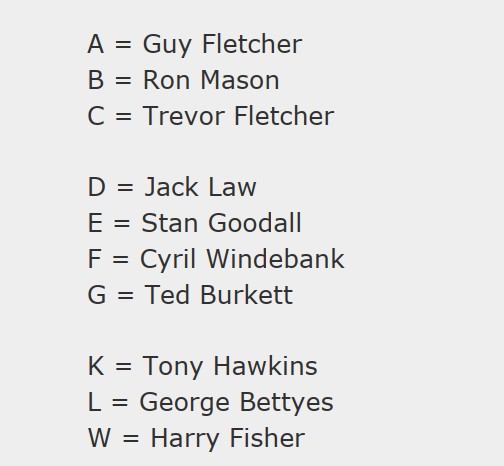
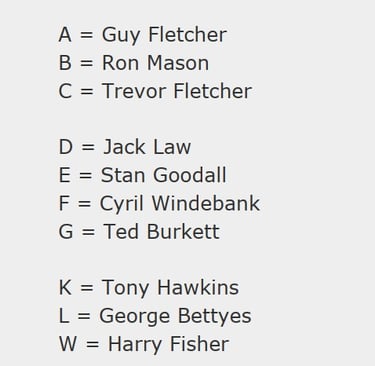
We have seen that the E code corresponds to Stan Goodall. Here is the list of the other technicians involved in cutting the lacquers, noting that B (Ron Mason) and C (Trevor Fletcher) have done much less work.
But what tools were available to cutting engineers to carry out their work?
At the birth of stereo, Decca used Neumann AM-32, a disk lathe with the ability of varying the groove pitch, controlled by the amplitude of the input signal, rather than a constant pitch. By mounting a preview head on the source tape deck, its signal could be fed to the lathe's drive, which made a small adjustment in the groove spacing approximately one-half rotation before the cutterhead received that same signal from the playback head
The Neumann ZS 90/45 stereo cutterhead (co-developed with Teldec, a joint venture of English Decca and German Telefunken) arrived in 1958 and combined vertical and lateral recording in a V-shaped groove, each slope set at an angle of 45 degrees. The ZS 90/45 was driven by the VG1 cutting electronics with two 60-watt tube amp (LV 60, push-pull EL156 tubes)
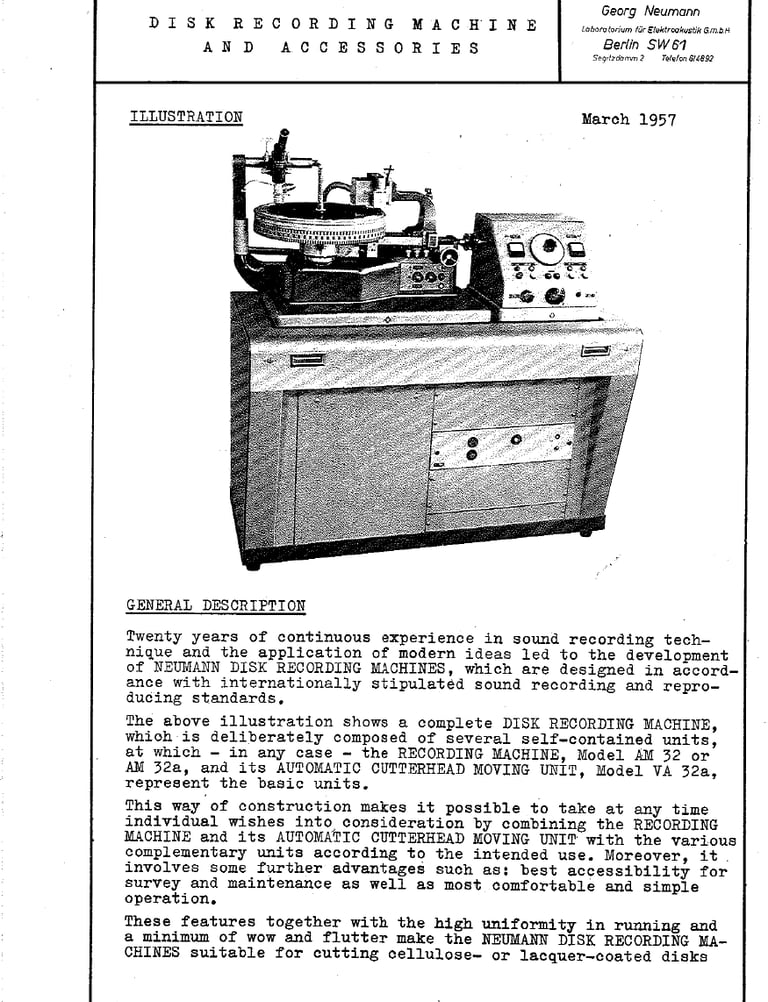
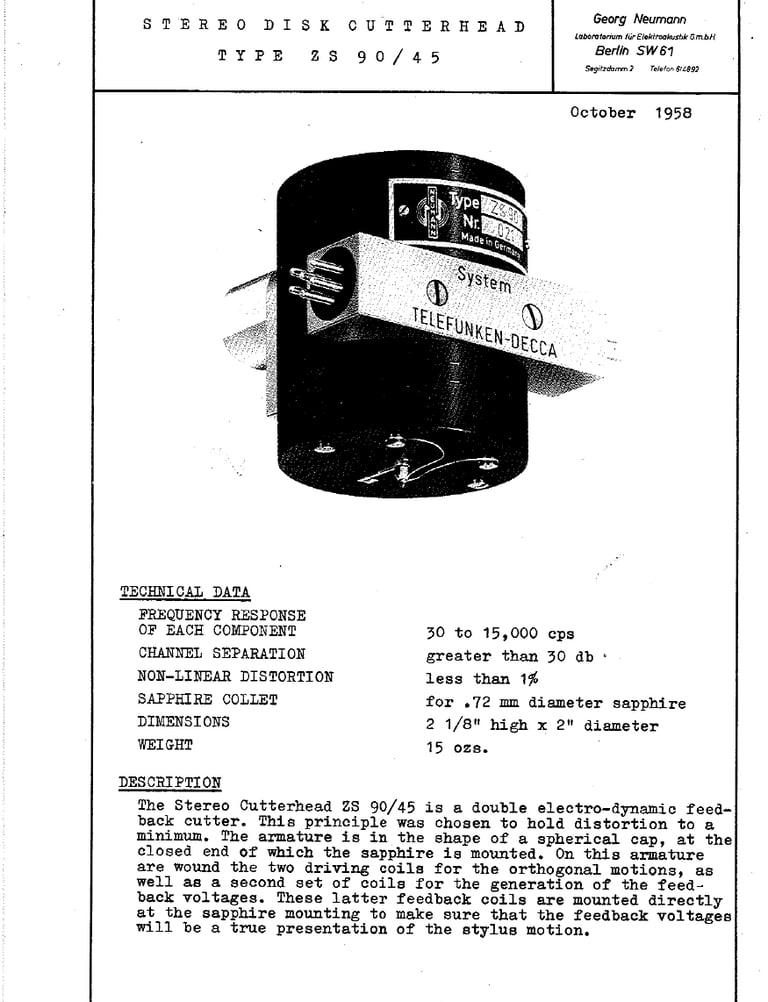
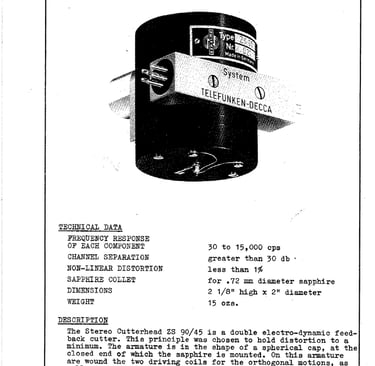
Why is it important to know which lathe and cutterhead was used in the cutting phase ?The type of cutter used ( and the quality of its maintenance) is an important influence
on the quality of lacquer cut from any tape.
All stereo discs cut between 1958 and 1968, the period in which the AM-32 and ZS 90/45 combination were used, were half-speed mastered.
What is half-speed mastering? When an LP is cut, both the master tape and the cutting lathe are reduced to half of their original speed. A master tape at 30 inches per second would be slowed to 15 ips, and the cutting lathe from 33⅓ to 16⅔ RPM.
Decca were half- speed cutting all LPs because of the relatively low high-frequency resonance of ZS 90/45 cutting head, which occurred a little way above 8kHz.
Half- speeding thus gave a top limit of 16kHz, which was an improvement, but at the same time introduced problems at low frequencies; furthermore, this affected the RIAA curve, because you had to apply only half the RIAA curve when cutting the lacquer ( and that’s not always easy to do ) and the response of playback heads is slightly different at 15 IPS than at 30 IPS.
The well-known mastering engineer Steve Hoffman, on his forum writes: "Decca boosted the treble when recording and reduced it around 5 dB at 8K or so when mastering in old days to reduce tape hiss. (before 1965 adoption Dolby A noise reducer)
If a British Decca recording has to be remastered, it must be remastered with the special Decca EQ box in the circuit or the recording will sound too bright and shrill. "
To top it all off, It's tougher to make adjustments during mastering, as you can't really hear what you're actually doing.
Does all this lead one to believe that the stereo lacquers produced in the 1958-68 period were of inferior quality to those produced later? No, absolutely not.
All the records of the golden age were produced with the AM-32 lathe, ZS 90/45 cutterhead, and LV60 tube amplifiers: even those remastered by Ted Burkett (probably the most famous mastering engineer at Decca, the G in deadwax) were largely produced before the adoption of the new Neumann SX-68 cutterhead.
In short, from what I've gathered from reading various documentation and interviews with Decca recording engineers, mastering engineers, and producers, in the early stages of the stereo era, the technicians had to invent tricks to solve the problems caused by the immaturity of the equipment at their disposal. The fact that they succeeded, and that, some 70 years later, their records still set the standard for sound quality, is a testament to their value.All this considered, the concept of rigorous adherence to the RIAA equalization curve becomes meaningless.
The topic of the evolution over time of the different sonic characteristics of the records within the Decca/King Records production will be the subject of a separate chapter.
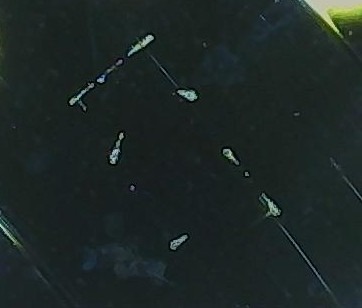
Let's now look at the dead wax of the Decca SXL at 12 o'clock and read the engraving KT while on the London CS we read ET. These are two of several codes of what is generally known as the tax code ( T stands for tax ) and indicates the period in which the disc was printed. In reality this code should be better defined (and at the time it was better known) as RPM (Retail Price Maintenance) and indicated the selling price that was controlled by each of the record manufacturers. This distinction is important (and for this information I have to thank Rob from rarityvalue) because not all the codes were used by all the producers and therefore it can happen to find a record with a code older than the pressing period (For example Decca in 1960/61 did not change the selling prices and continued to use the ET code from 1959)
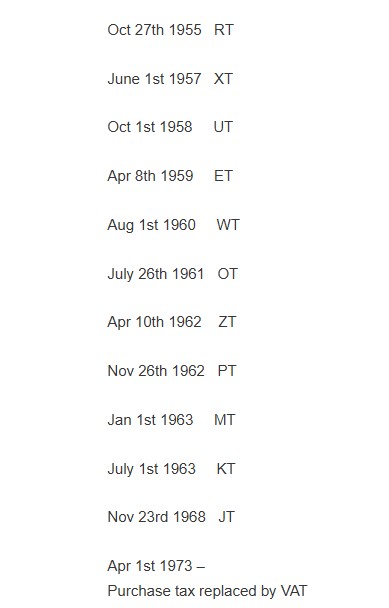
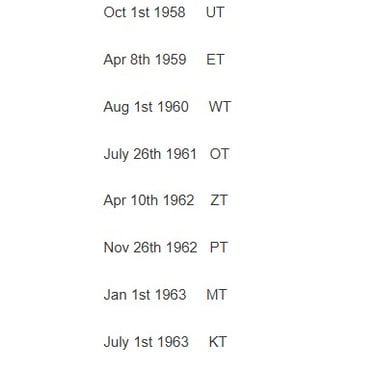
The table below highlights the codes used from 1959 to 1973 which are valid for all record producers in UK, including both the Decca and the London since they were printed in the same factories in the UK.
It cannot be stated with absolute certainty, but records pressed with a code prior to JT (Nov 68) should use lacquers cut with the ZS 90/45 cutterhead.
This table courtesy of https://londonjazzcollector.wordpress.com/
Decca KT code London ET code
After looking at 6 and 12 o'clock, we try to look at 9 o'clock and we find the engraved writing 1. That is the number of the "mother", information of relative utility if we do not know what the "mother" is. So let's take a step back and return to Stan Goodall who has just finished cutting the lacquer ZAL5036 1E; this lacquer (a 14" diameter aluminum disc covered in lacquer) constitutes a "positive" and could be played on a turntable if it were not so delicate. This lacquer will be used to obtain, through a plating process, a nickel-coated copy called "father" or "master" which will constitute a "negative". Since it is so delicate, from one lacquer you get only one father. The latter could be used to press records but generally, always through a plating process, is used to produce more "mothers". Deriving from a negative, the mother is a positive like the lacquer and could be played on a turntable but instead it will be used, through the final plating process, to obtain the "stampers" which will be negatives intended to press the records. So, to recap: from a lacquer (positive) you get only one father (negative) from which you get multiple mothers (positive) and from each mother you get multiple stampers (negative)..The above method of creating a stamper is known as a three-step plating process and it is alternative to the so called one step processing where the father is used as the stamper. The one step system has never been adopted by the major record companies because, although it allows for better quality, it limits the quantity of copies to a few hundred for each lacquer and is therefore absolutely unsuitable for medium and large runs


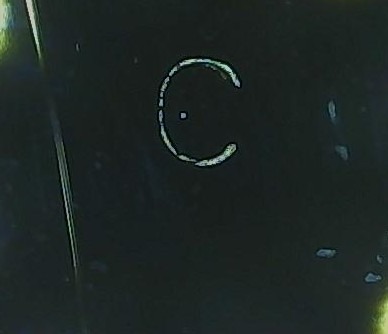
At this point we just have to look at 6 o'clock, where we find the letter B on the Decca SXL and the letter C on the London CS. These letters are part of the so-called Buckingham code used by Decca to number the stampers; with this code the 10 letters that make up the word Buckingham replace the numbers from 1 to 10. Therefore, B corresponds to the number 1, M corresponds to 10, and to indicate the eleventh stamp, BB is used.
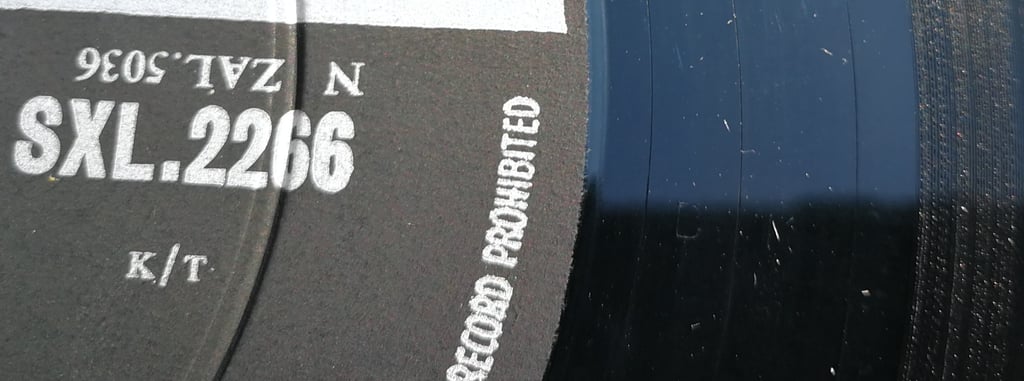
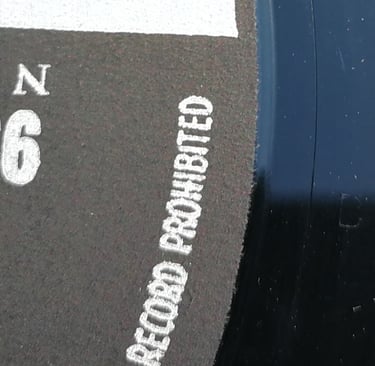
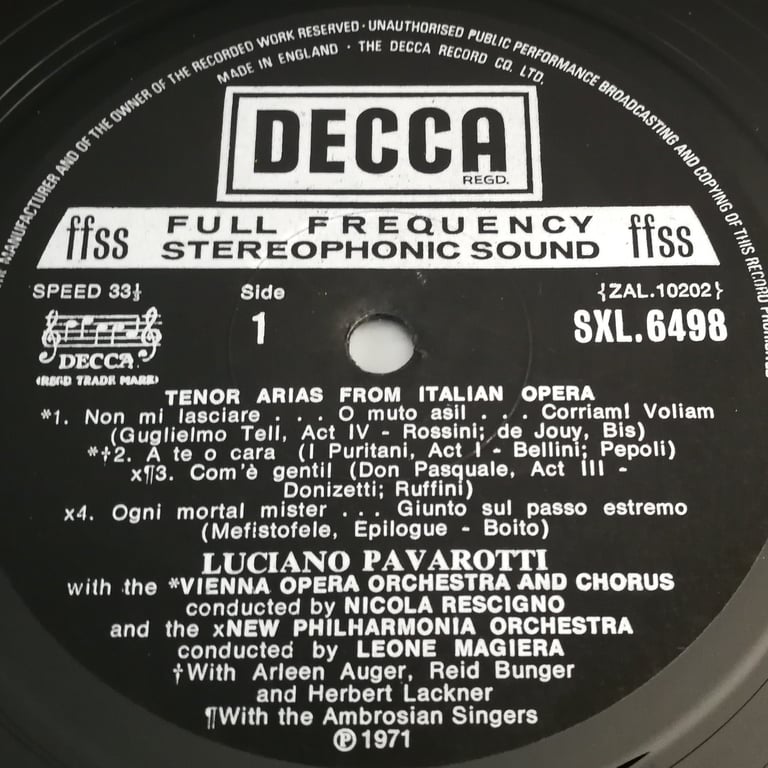
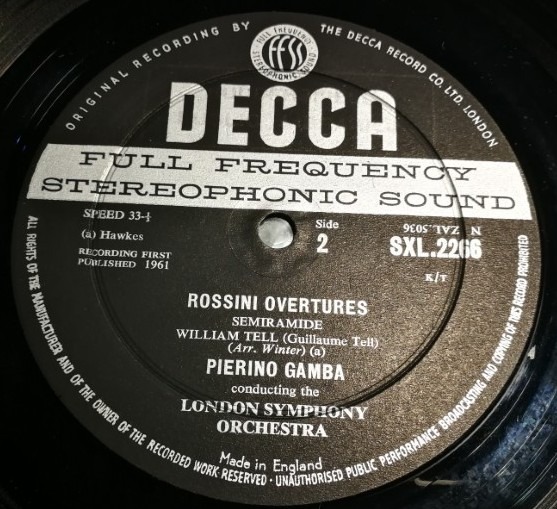
Now let's analyze the labels. The first ones are called wide band because there is the silver band with the writing "Full Frequency Stereophonic Sound" just above the spindle hole . The first wide band label appeared in 1958 and it is the so-called ED1. It has "Original Recording by" written between 9 & 12 o'clock, round the edge of the label and has a deep groove in the vinyl, under the label, about 1cm from the outer edge. This deep groove is obviously caused by the pressing machine and gives us a rough indication of the period in which the record was printed. The last ED1s were printed in 1965/66 but some reissues used these labels, which were available as remnants, until 1968
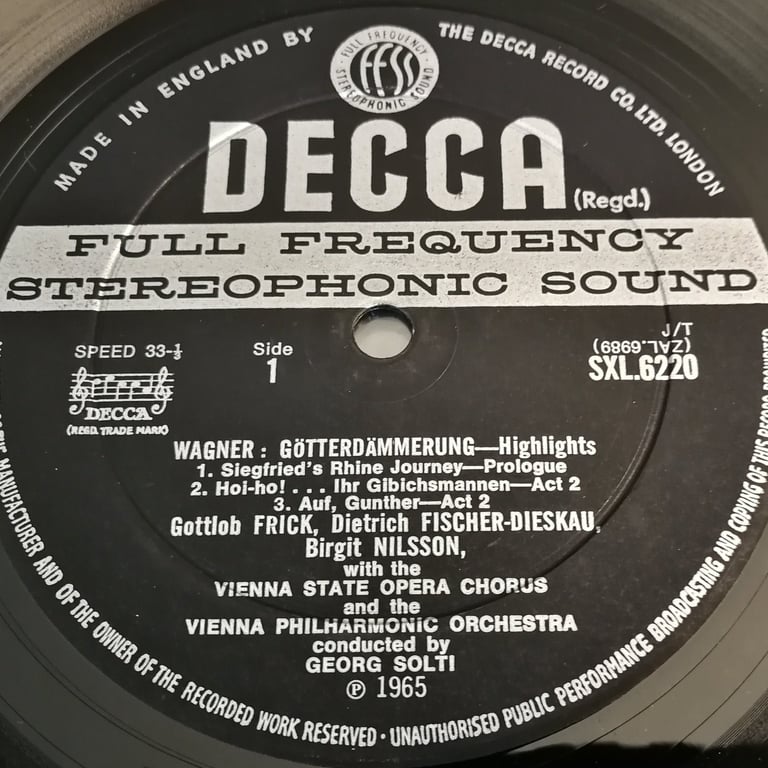
The ED2 version appears in the years 1965/66 and ends in 1969. It is substantially the same as the ED1 version and the main difference is the writing "Made in England by" that replaces "Original recording by ". The ED2 version the deep groove remains
The ED3 version appears in 1969 and ends in 1970. It is substantially the same as the ED2 version and the only difference is that it does not have the deep groove.
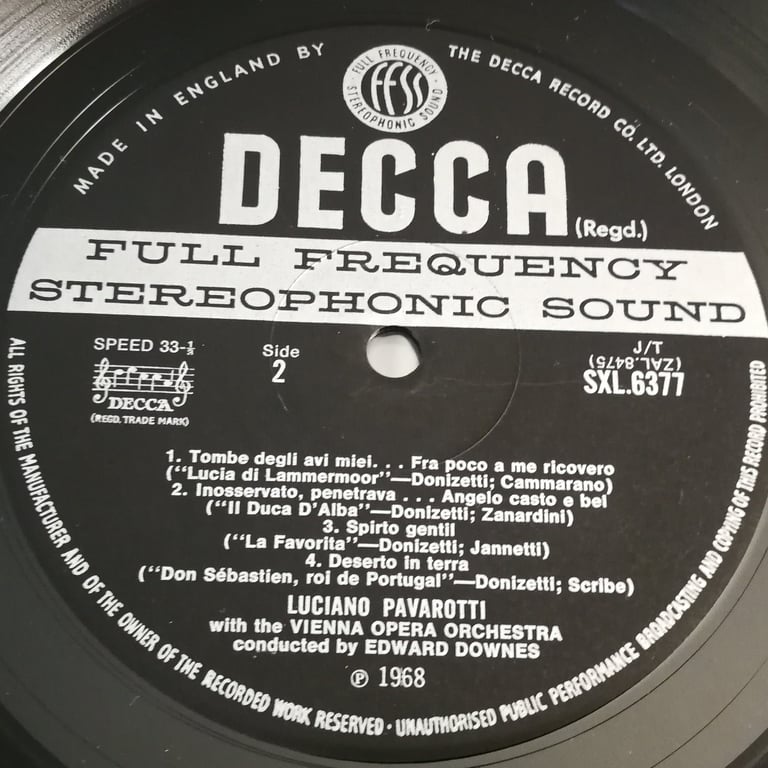
The ED4 version is the first so-called " narrow band label ". It takes this name because the silver band saying “Full Frequency Stereophonic Sound” is narrower than the wide band on ED1, ED2, ED3. It appears in 1970 and will end in 1979 when Decca will stop producing records in the UK and will move production to Holland.